


Ask a founder or team leader what keeps their people engaged and you will hear about company benefits, mission and growth opportunities. Rarely does anyone mention the sound of the office. Yet for the people doing the work, noise is one of the most persistent frustrations of office life, and it can quietly erode the things leaders say they care about: quality of output.
A UK study published in April 2026 by Oscar Acoustics, reported by Workplace Journal, found that office professionals lose an average of 26 minutes of productive time a day to noise, with 44% saying both the quality and quantity of their work suffer. That adds up to more than three working weeks per employee per year.
If you are the person who signed the lease, chose the layout and set the culture, the office noise problem is yours to fix. The good news is that fixing it doesn’t require a redesign.
The more telling figure for leaders is this: 54% of employees described their workplace as noisy, yet only around a third believe their employer takes the issue seriously. But that gap between what staff experience and what leadership notices is where the opportunity lies.
The costs of a noisy office
The open-plan office was sold to a generation of founders as the engine of collaboration, and it has delivered plenty of collaboration, but at the cost of concentration.
Data from Leesman, a global business intelligence firm, shows that 70% of employees rate noise levels as a contributor to the quality of their work, yet only 35% are satisfied with them, which keeps acoustics among the lowest-scoring features of the modern workplace.
Recovering even half of those 26 lost minutes per person per day, across a team of 30, returns roughly 1,600 hours a year. That is close to a full-time hire, recovered without a single new salary.
Constant background speech is draining because the brain cannot fully tune out language; it keeps half-listening whether we want it to or not. That low-level cognitive load compounds into fatigue, irritability and the sense of having worked hard all day without finishing anything. For the roughly 30% of people who are more sensitive to noise, including neurodivergent staff and those with sensory impairments, the effect is sharper still.
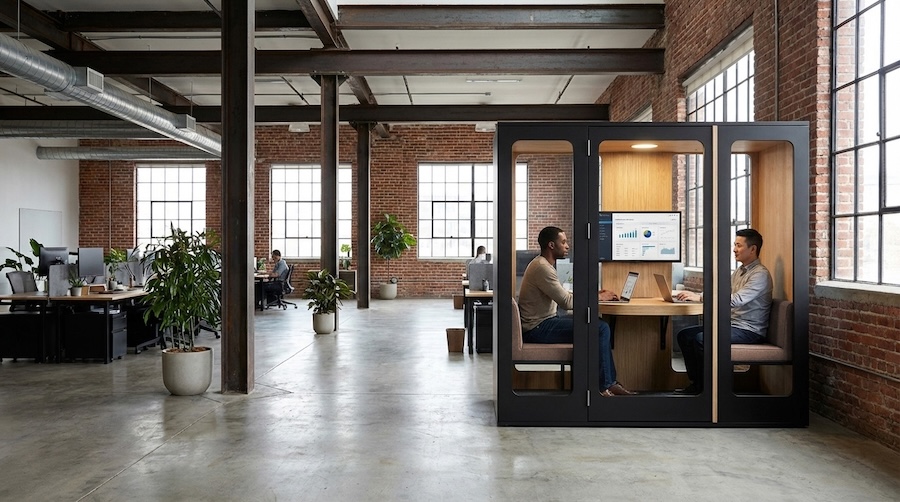
Headphones are a patch, not a fix. What people are really asking for is control, somewhere to go when they need to think, and somewhere to take a call without broadcasting it to the floor. Increasingly, that takes the form of enclosed spaces such as acoustic office pods, which give teams a private room without the cost or disruption of building one.
If you are the person who signed the lease, chose the layout and set the culture, the office noise problem is yours to fix. The good news is that fixing it doesn’t require a redesign.
5 things founders can do this quarter
1. Audit how the space is used. Spend a day watching rather than working. Where do people take calls? Where do they retreat to when they need to think? If the answer is the stairwell or a café down the road, your office is telling you what it lacks.
2. Separate the loud work from the quiet work. Most offices try to do everything in one acoustic zone. Instead, deliberately decide where calls, stand-ups and brainstorms happen, and protect the rest for heads-down work. This is a cultural decision as much as a spatial one; it needs a leader to say it out loud.
3. Add private spaces without building walls. A single-person booth for calls and a four-person pod for small meetings can take the pressure off an entire floor. They install in a day, need no planning permission and move with you if you outgrow the space.
4. Model the behaviour yourself. If the founder takes every call at their desk, so will everyone else. Book the pod. Wear the headphones. Staff read what leaders do far more closely than what they write in the handbook.
5. Measure it. Add two questions to your next pulse survey: “Can you find a quiet place to concentrate when you need one?” and “can you take a private call without leaving the office?” Track the answers over time. What gets measured gets funded.
The return on “quiet” workspaces
Leaders are used to investing in tools, training and talent. Investing in the acoustic environment sits in the same category, and the payback is unusually direct.
Recovering even half of those 26 lost minutes per person per day, across a team of 30, returns roughly 1,600 hours a year. That is close to a full-time hire, recovered without a single new salary.
The wellbeing return is harder to put on a spreadsheet but no less real. People who can control when they are exposed to noise report lower stress, better recovery between tasks and more satisfaction with where they work.
In a market where retaining good people is cheaper than replacing them, a quieter office is one of the least expensive retention tools available.
Start small, start now
None of this requires a new building or a six-figure budget. It requires a leader to treat the acoustic environment as part of how the business runs, alongside tools, training and talent.
Start with a conversation; ask your team where they go when they need to concentrate, and what would help them do their best work at their desk. The answers will point to the changes worth making, and most of them are quicker and cheaper than founders expect.
A quieter office is one of the few investments that improves wellbeing, focus and retention at the same time, and it is well within any leader’s reach. Start now.


